
Looking for reliable internet speed for your new home?
Utility Helpers has expertise in setting up internet service with notable providers to make your move easy. Let's begin by understanding how internet speed is measured. Internet speed is measured in either megabits per second (Mbps) or gigabits per second (Gbps).
Which is faster Mbps or Gbps?
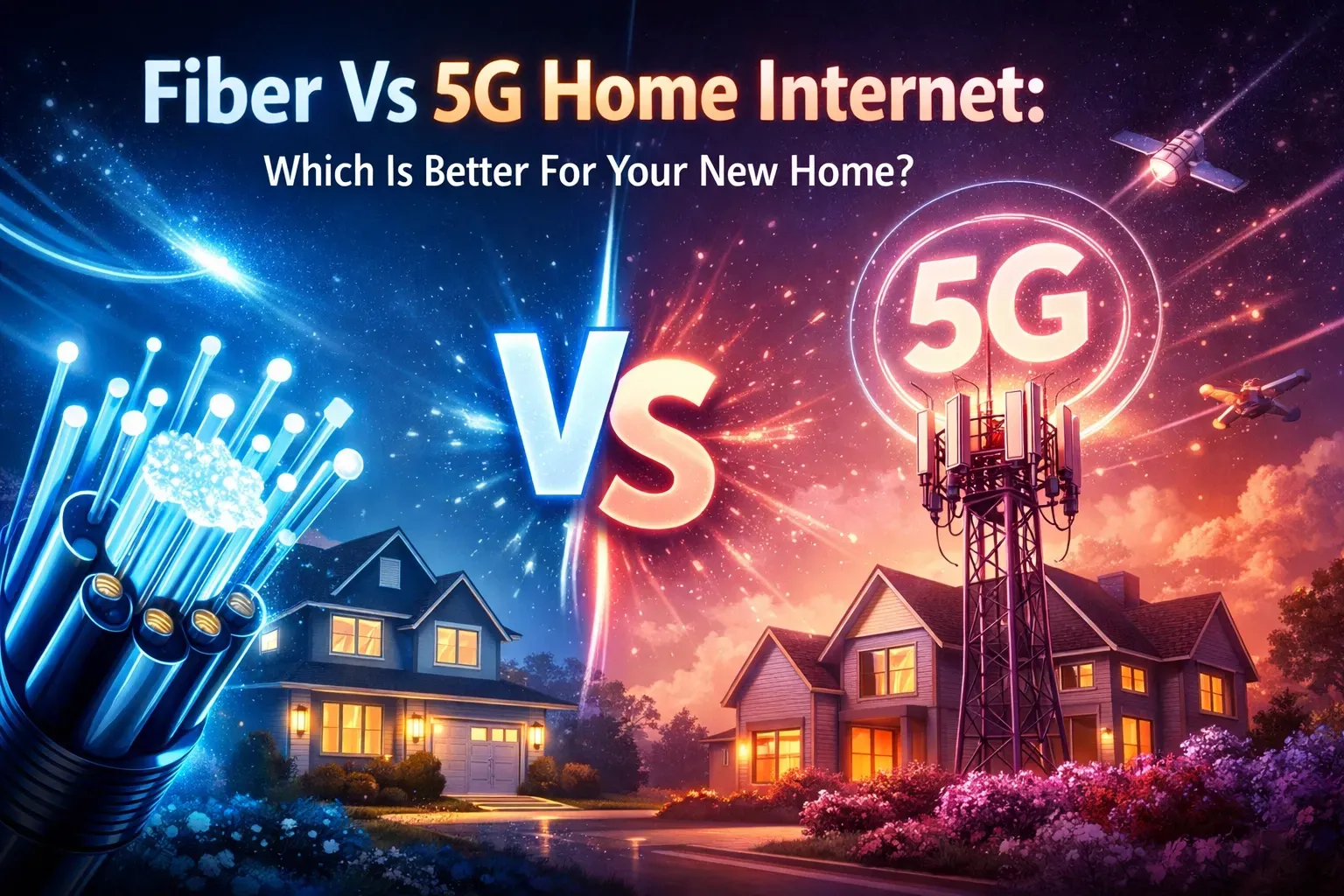
Fiber vs Coaxial Data Connection The main differences between a fiber and coaxial wire is that a fiber cable comprises of glass optical fibers and uses light to carry data, therefore it enables a fast and consistent internet speed. Meanwhile, a coaxial cable comprises of copper and uses electricity to carry data. Coaxial often times is noticeably slower than a fiber connection. One of the biggest differences comes with bandwidth symmetry; Fiber has uniform download/upload speed (i.e. 100 Mbps upload / 100 Mbps download). Whereas a coaxial connection is asymmetrical (i.e. 100 Mbps / 20 Mbps upload).
To avoid any interruption in service, we recommend you contact Utility Helpers to allow our professional representatives to assist you in getting connected with the best internet provider available at your new home .
Utility Helpers has expertise in setting up internet service with notable providers to make your move easy. Let's begin by understanding how internet speed is measured. Internet speed is measured in either megabits per second (Mbps) or gigabits per second (Gbps).
Which is faster Mbps or Gbps?
- A higher Mbps rate equals a faster connection speed. For example 500 Mpbs is higher than 100 Mbps. When it comes in terms of Gbps (gigabit) is composed of a 1,000 Mbps (megabits). Gbps is higher than Mbps.
- The abbreviations Mbps and Gbps are commonly mistaken for megabytes (MB) or gigabytes (GB); both megabytes and gigabytes are used to measure the capacity of data storage, in example your computer's hard drive.
- A way to determine what internet speed is needed, first list all the things you use the internet for.
- How many devices are running on your network?
- If you are using multiple devices in your home, it is suggested to use "gig-speeds" to reduce loading times.
- Are you using streaming services (such as Netflix)?
- When using streaming service, it is suggested to take into consideration how many devices are consecutively streaming in your home network. Most clients stream from devices such as smart TV's, tablets or smart phones. Suggested speeds are 500 Mbps to 1 Gbps.
- Are you running a small business or work from home?
- Working from home requires a more consistent connection or speed to upload documents, send emails, use a fax machine or answer work calls (only if you have a phone that works off the internet; commonly known as Voice Over Internet Protocol or Voip). Suggested speed is 1Gbps.
- Does your home have a security system with cameras?
- Investing in a security system is one of the first things we do when buying a home. Security systems do not demand high speed internet. However, if you have cameras with your security system and they are recording 24/7, a higher speed might be required to experience minimal buffering and to avoid the cameras from missing an important event. Suggested speeds are 500 Mbps to 1 Gbps.
- Are there any gamers in your family?
- Surprisingly, gaming typically does not demand high speed internet bandwidth. However, a reliable FIBER connection is recommended to prevent congestion in your home network. An ideal fiber internet speed for gamers is above 300 Mbps and an ideal coaxial internet speed is at least 500Mbps to 1 Gbps.
Fiber vs Coaxial Data Connection The main differences between a fiber and coaxial wire is that a fiber cable comprises of glass optical fibers and uses light to carry data, therefore it enables a fast and consistent internet speed. Meanwhile, a coaxial cable comprises of copper and uses electricity to carry data. Coaxial often times is noticeably slower than a fiber connection. One of the biggest differences comes with bandwidth symmetry; Fiber has uniform download/upload speed (i.e. 100 Mbps upload / 100 Mbps download). Whereas a coaxial connection is asymmetrical (i.e. 100 Mbps / 20 Mbps upload).
To avoid any interruption in service, we recommend you contact Utility Helpers to allow our professional representatives to assist you in getting connected with the best internet provider available at your new home .

By Jonathan Brown
•
March 24, 2026
Moving soon? Learn how to set up utilities and home services once your contract is signed. Get everything active by closing day for a stress-free move-in!"
How does that look to you, Jonathan? If you're happy with those, I can help you with the next article on your list! ✍️✨